
Shopping for a mortgage without comparing rates is like buying a car without checking the sticker price. You might pay thousands more than you have to. In Virginia markets like Richmond, Chesterfield, Fredericksburg, and Virginia Beach, even a 0.25% rate difference on a $350,000 loan can shift your monthly payment by $50 to $60 and cost tens of thousands over a 30-year term.
The good news: mortgage rate comparison tools have made it easier than ever to shop dozens of lenders simultaneously, without the phone calls, the hard credit pulls, or the pressure. But not all comparison tools are created equal. Some show you teaser rates that vanish at application. Others require a hard credit inquiry just to see a number. A few are genuinely useful.
This guide reviews the best mortgage rate comparison tools available to Virginia, Florida, Tennessee, and Georgia homebuyers in 2026, including what each does well, where it falls short, and who it’s best for. We start with the tool that offers something most others don’t: access to hundreds of lenders with no credit hit.
Rates and features current as of May 2026. Always verify current rates directly with lenders. Not a rate quote or commitment to lend.
How Mortgage Rate Comparison Tools Actually Work
Before diving into the tools, it helps to understand what you’re actually looking at. Mortgage rate comparison tools fall into four broad categories, and knowing which type you’re using changes how you interpret the results.
Lead-generation aggregators like LendingTree and Bankrate display rates from lender partners and earn revenue when borrowers click through or submit their information. The rates shown are real, but they come from paying advertisers, not every lender in the market.
Single-lender digital platforms like Rocket Mortgage give you a polished, fast experience, but you’re only seeing one lender’s pricing. There’s no competitive pressure on their rates because there’s no competition in the room.
Editorial rate trackers like NerdWallet or the CFPB Rate Checker provide rate context and education without directly originating loans. Useful for benchmarking, not for closing.
Broker-powered multi-lender platforms shop your actual loan profile across many lenders simultaneously. This is where genuine competition happens, and where borrowers with complex situations, lower credit scores, or non-standard income tend to find options that banks miss.
With that framework in place, here are the top mortgage rate comparison tools for Virginia homebuyers in 2026.
1. Fetch My Mortgage
Best for: Virginia homebuyers who want to shop hundreds of lenders without a credit hit
Fetch My Mortgage is a Virginia-based mortgage shopping platform led by Duane Buziak (NMLS#1110647) that uses a soft-pull Vantage Score 4.0 to shop hundreds of lenders simultaneously, with no hard credit inquiry at the comparison stage. Licensed in VA, FL, TN, and GA.

Where This Tool Shines
Most comparison tools force you into a binary: see generic rates with no personalization, or submit to a hard credit pull. Fetch My Mortgage’s NoTouch Credit approach uses a Vantage Score 4.0 soft pull, meaning your credit score isn’t affected while you’re still shopping. That’s a meaningful difference for borrowers who are rate-sensitive, credit-sensitive, or both.
The platform’s breadth is the other major differentiator. Where a bank or credit union offers their own products only, Fetch My Mortgage shops across hundreds of wholesale and retail lenders. For borrowers who’ve been turned down by a local bank in Richmond, Chesterfield, or Fredericksburg, that breadth is often the difference between getting a loan and not getting one at all.
Key Features
NoTouch Credit (Vantage Score 4.0): Soft-pull technology lets borrowers see real, personalized rate options without any impact to their credit score at the shopping stage.
Hundreds of Lenders: Shops wholesale and retail lenders simultaneously across purchase, refinance, and cash-out scenarios, creating genuine rate competition.
Credit Scores to 500: Works with lenders who accommodate FHA program guidelines down to 500, well below the 620+ floor at most conventional lenders.
Cash-Out Refinance to 90% LTV: Above the standard 80% LTV cap at most conventional lenders and above FHA’s 80% cash-out ceiling, giving homeowners access to more of their equity.
Speed to Close: In competitive Virginia markets like Short Pump, Glen Allen, and Midlothian, fastest-in-class close times strengthen purchase offers and keep transactions on schedule.
Best For
Borrowers in Virginia, Florida, Tennessee, or Georgia who want genuine multi-lender competition without a credit hit. Especially valuable for buyers with credit scores below 620, self-employed borrowers, homeowners pursuing cash-out refinancing, and anyone who’s been turned down by a bank or credit union and needs access to non-QM or alternative lender options.
Pricing
No upfront cost to compare rates. Origination fees are disclosed transparently at application. Contact Fetch My Mortgage directly for current program details and available lender options.
2. Bankrate Mortgage Rate Comparison
Best for: Borrowers who want a rate benchmark and educational context before talking to a lender
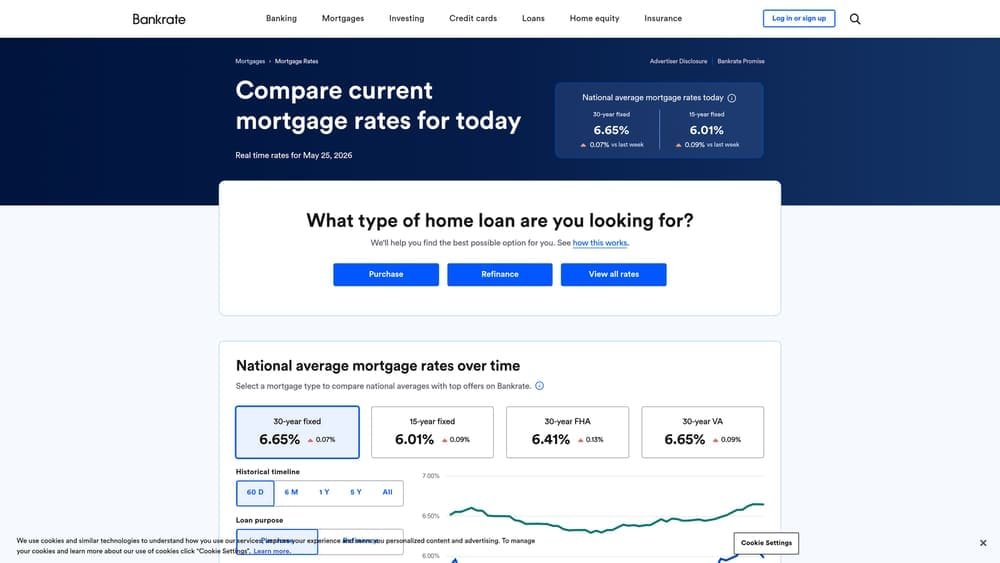
Bankrate is one of the most widely used rate aggregator platforms, displaying daily mortgage rate tables from lender partners alongside calculators, editorial reviews, and educational content.
Where This Tool Shines
Bankrate’s rate tables are updated daily and organized by loan type, term, and state, making it a solid starting point for understanding where the market is. The editorial content explaining rate trends is genuinely useful for borrowers trying to understand whether to lock now or float.
The calculator suite is strong. You can run payment estimates, affordability scenarios, and refinance breakeven math in one place. For a first-time buyer in Charlottesville or Williamsburg trying to understand the numbers before calling a lender, Bankrate is a reasonable research tool.
Key Features
Daily Rate Tables: National and state-level rate data updated daily, filterable by loan type, term, credit score range, and down payment.
Mortgage Calculator Suite: Covers payment estimates, affordability analysis, and refinance breakeven calculations.
Lender Reviews: Star ratings and editorial reviews for lender partners help borrowers evaluate options beyond the rate alone.
Rate Trend Context: Editorial coverage of rate movements helps borrowers understand the broader market environment.
Filter Tools: Narrow results by loan type (conventional, FHA, VA, jumbo), term, and borrower profile.
Best For
Borrowers in the early research phase who want to benchmark rates before engaging a lender. Useful as a starting reference point, but not a substitute for actual multi-lender shopping with your real credit profile and loan details.
Pricing
Free to use. Bankrate earns revenue from lender advertising partners. Rates shown are from paying lenders, which means the full market isn’t represented. Always verify rates directly with lenders before making decisions.
3. LendingTree Mortgage
Best for: Borrowers who want multiple competing loan offers from a single application
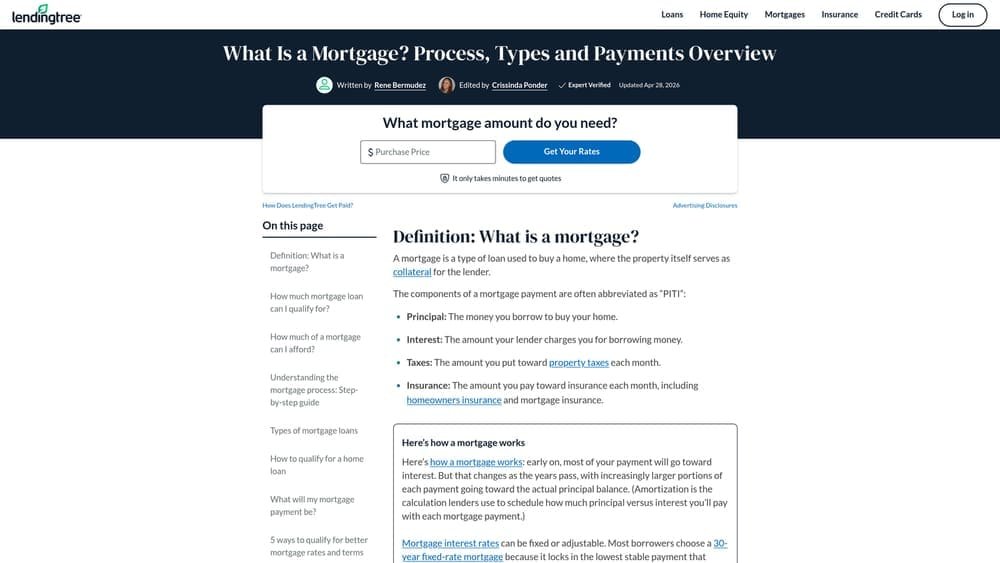
LendingTree is a marketplace that collects borrower information through a single form and generates competing loan offers from multiple lender partners. It’s one of the largest mortgage lead-generation platforms in the country.
Where This Tool Shines
The core promise is real: submit once, get multiple offers. For borrowers who want to see competing quotes without filling out five separate applications, LendingTree reduces that friction. The My LendingTree dashboard lets you track offers and monitor your credit score in one place.
Coverage is broad across purchase, refinance, and home equity products. The lender reviews and comparison tools help borrowers evaluate offers beyond the headline rate, which matters when fees vary significantly between lenders.
Key Features
Single-Form Multi-Offer: One application generates competing loan offers from multiple lender partners, reducing application fatigue.
Lender Competition: Lenders compete for your business, which can surface better pricing than approaching lenders individually.
Product Coverage: Covers purchase loans, refinancing, and home equity products across loan types.
My LendingTree Dashboard: Centralized tracking of offers and credit score monitoring.
Lender Reviews: Borrower reviews and comparison tools help evaluate lender quality alongside pricing.
Best For
Borrowers with straightforward profiles who want to generate multiple quotes quickly and are comfortable with lender follow-up. Less ideal for borrowers with complex income situations, lower credit scores, or those who prefer a guided process with a single point of contact.
Pricing
Free for borrowers. LendingTree sells borrower lead data to lender partners. Expect significant follow-up contact by phone, email, and text after submitting your information. Rates shown in initial offers may not reflect final pricing after full underwriting review.
4. Rocket Mortgage
Best for: W-2 borrowers with strong credit who want a fast, fully digital application experience
Rocket Mortgage is the largest U.S. mortgage lender by volume, offering a fully digital application experience with real-time rate quotes and verified approval letters. It’s a single-lender platform, not a comparison tool.
Where This Tool Shines
Rocket’s digital experience is genuinely excellent. The application is clean, fast, and well-designed. For a W-2 borrower with a 720+ credit score buying in a standard market, Rocket can move quickly from application to approval. The Verified Approval Letter (VAL) is a real competitive advantage in tight markets, signaling to sellers that financing is solid.
The mobile app is strong, and the range of loan products covers most standard borrower needs. If your situation is straightforward and you value speed and UX over rate competition, Rocket is a credible choice.
Key Features
Fully Digital Application: End-to-end digital process from rate quote to closing, with real-time status updates.
Verified Approval Letter: Stronger than a standard pre-approval, the VAL can strengthen purchase offers in competitive markets.
Real-Time Rate Lock: Lock your rate during the application process with live market pricing.
Mobile App: Well-rated app for managing the application and communicating with the loan team.
Loan Product Range: Conventional, FHA, VA, and jumbo products available.
Best For
W-2 borrowers with strong credit (620+, ideally 700+) who want a fast, self-directed digital experience and don’t need broker access to wholesale pricing. Not the right fit for self-employed borrowers, credit scores below 620, or complex income situations where a broker’s lender network becomes essential.
Pricing
Rates and fees vary by loan type and borrower profile. Origination fees apply. Rates are available after starting the application. Because Rocket is a single lender, there is no competitive pressure on their pricing from other lenders during your session.
Understanding the Rate Difference: Why Comparison Matters
Here’s a concrete illustration of why rate shopping is worth the effort. The table below shows how different rates affect a $350,000 30-year fixed-rate mortgage. These are illustrative calculations for educational purposes only and do not represent a rate quote or commitment to lend. Actual rates vary by credit score, loan type, LTV, and lender.
Rate Impact Table: $350,000 Loan, 30-Year Fixed (Illustrative)
Rate: 6.50% | Monthly P&I: $2,213 | Total Interest (30 yr): $446,680
Rate: 6.75% | Monthly P&I: $2,270 | Total Interest (30 yr): $467,200
Rate: 7.00% | Monthly P&I: $2,329 | Total Interest (30 yr): $488,440
Rate: 7.25% | Monthly P&I: $2,388 | Total Interest (30 yr): $509,680
The difference between 6.50% and 7.25% on the same loan is $175 per month and over $63,000 in total interest over 30 years. That’s the financial case for comparison shopping in a single table.
Breakeven Math: Should You Buy Down Your Rate?
One of the most common questions Virginia homebuyers face is whether to pay points to buy down their rate. Here’s how to work through that decision with real math. This is an illustrative example for educational purposes only, not a rate quote.
Scenario: You’re offered 7.00% with no points, or 6.75% with 1 point (1% of the loan amount).
Step 1: Calculate the point cost. On a $350,000 loan, 1 point = $3,500 paid at closing.
Step 2: Calculate the monthly savings. At 7.00%, your monthly P&I is $2,329. At 6.75%, it’s $2,270. Monthly savings = $59.
Step 3: Calculate breakeven. $3,500 ÷ $59/month = approximately 59 months, or just under 5 years.
Conclusion: If you plan to stay in the home for more than 5 years, buying the point saves money over time. If you plan to sell or refinance within 5 years, skip the point and keep the $3,500 in your pocket.
This math applies to any rate buydown scenario. The variables change, but the framework is always: cost of the point ÷ monthly savings = breakeven in months.
Loan Type Quick Reference
Different loan programs have different credit score requirements, down payment minimums, and ideal use cases. Here’s a structured reference based on publicly available program guidelines from HUD, VA.gov, and USDA.
Conventional | Min Credit: 620 | Min Down Payment: 3% | Best For: Strong credit borrowers, standard purchase or refinance transactions.
FHA | Min Credit: 500 (10% down) or 580 (3.5% down) | Min Down Payment: 3.5%–10% | Best For: Lower credit scores, first-time buyers, borrowers rebuilding credit. Source: HUD published program guidelines.
VA | Min Credit: No federal minimum (lender overlay typically 580+) | Min Down Payment: 0% | Best For: Eligible veterans and active-duty military in Virginia and other licensed states. Source: VA.gov published guidelines.
USDA | Min Credit: 640 (typical) | Min Down Payment: 0% | Best For: Rural Virginia areas including Louisa, Caroline County, Goochland, and parts of the Northern Neck. Source: USDA published program guidelines.
Fetch My Mortgage works with lenders across all four loan types, including FHA lenders who accept scores down to 500, which most retail banks and credit unions do not offer.
Head-to-Head: Fetch My Mortgage vs. Key Competitors
Honest comparison matters. Here’s how Fetch My Mortgage stacks up against the most common alternatives Virginia homebuyers encounter, without talking down any competitor.
vs. Rocket Mortgage: Rocket offers excellent digital UX and strong brand trust. It’s a good fit for W-2 borrowers with clean credit who want speed and a self-directed experience. Rocket is a single lender, meaning you see only their pricing. Fetch My Mortgage shops hundreds of lenders, creating price competition that a single lender cannot replicate. For complex income, lower credit scores, or non-QM situations, the broker model wins on options.
vs. CapCenter (Richmond-based): CapCenter’s no-origination-fee model is genuinely appealing and worth considering for cost-conscious buyers in the Richmond market. Their model limits you to their own products. Fetch My Mortgage has origination fees that are disclosed transparently at application, but accesses a much broader lender network. For borrowers who need competitive shopping across many lenders, the breadth matters more than the fee structure alone.
vs. LendingTree: LendingTree generates multiple quotes from one form, which sounds similar to what a broker does. The key difference: LendingTree is a lead-generation platform. Your information is sold to lender partners, and you manage the follow-up process yourself. Fetch My Mortgage is a broker: one point of contact manages the entire process, shops lenders on your behalf, and guides you to closing.
vs. Veterans United: Veterans United is an excellent, specialized lender for VA loans. If you’re an eligible veteran or active-duty service member, they deserve a look. They are not a broad comparison tool and don’t serve non-VA borrowers. Fetch My Mortgage handles VA loans alongside conventional, FHA, USDA, and non-QM products.
vs. Bankrate/NerdWallet: Both are research tools, not lenders or brokers. They’re useful for benchmarking and education. They cannot originate your loan, and the rates shown reflect paying advertisers, not the full market.
When Your Bank Says No: The Broker Advantage
Here’s a scenario that plays out regularly in Virginia: a homebuyer applies at their local credit union in Chesterfield or Henrico, gets turned down because their credit score is 575 or their income is self-employed with complex write-offs. The bank’s system says no, and the buyer assumes they’re not eligible for a mortgage.
This is where broker access to a wide lender network changes the outcome. To illustrate, imagine a borrower with a 560 credit score and two years of self-employment income. A retail bank applies their own overlay requirements and declines. A broker with access to FHA lenders who work down to 500, and to non-QM lenders who use bank statement income instead of tax returns, can often find a path forward.
This is a clearly hypothetical illustration of how the broker model works in practice, not a specific case study. The principle is real: more lenders mean more options, especially for borrowers who don’t fit a conventional profile.
Frequently Asked Questions
Does comparing mortgage rates hurt my credit score?
Using a soft-pull tool like Fetch My Mortgage’s NoTouch Credit does not affect your credit score at the comparison stage. When you do proceed to formal application with multiple lenders, FICO’s published scoring methodology typically counts multiple mortgage inquiries within a 14 to 45-day window as a single inquiry, minimizing the impact of rate shopping.
What credit score do I need to get the best mortgage rate?
Conventional lenders typically offer their best pricing at 740 and above. FHA programs accept scores down to 500 with a 10% down payment, or 580 with 3.5% down (per HUD published guidelines). Fetch My Mortgage works with lenders who accept scores down to 500, which opens options for borrowers who would be declined at most retail lenders.
Can I get approved with a 500 credit score in Virginia?
FHA guidelines permit scores as low as 500 with a 10% down payment. Not all lenders offer this program, even though FHA allows it. Fetch My Mortgage has access to lenders who do. If you’ve been turned down by a bank or credit union, that’s not necessarily the end of the road.
What’s the difference between a rate aggregator and a mortgage broker?
A rate aggregator like Bankrate or NerdWallet displays rate data from lender partners but doesn’t originate loans. You’re responsible for following up with each lender yourself. A mortgage broker like Fetch My Mortgage actively shops your loan across many lenders, manages the process, and works with you through to closing. One is a research tool; the other is a service.
How do I know if a rate quote is real or a teaser rate?
Ask for the APR, not just the interest rate. The APR includes fees and gives you a more complete picture of the loan’s cost. Confirm whether points are included in the quoted rate. Request a Loan Estimate, which lenders are required by law to provide within three business days of a completed application. Compare APRs across lenders for a true apples-to-apples comparison.
Which states does Fetch My Mortgage serve?
Fetch My Mortgage is licensed in Virginia, Florida, Tennessee, and Georgia. The platform has deep expertise in Virginia markets including Richmond, Short Pump, Glen Allen, Chesterfield, Midlothian, Henrico, Hanover, Fredericksburg, Spotsylvania, Stafford, Charlottesville, Williamsburg, Virginia Beach, Hampton Roads, Chesapeake, and Newport News.
Which Tool Is Right for Your Situation?
Here’s a quick-reference guide to matching your situation to the right tool.
You want to shop hundreds of lenders without a credit hit: Fetch My Mortgage. NoTouch Credit, soft-pull Vantage Score 4.0, no impact to your score at the comparison stage.
You have a credit score below 620: Fetch My Mortgage. Access to FHA lenders down to 500 and non-QM options that most retail banks don’t offer.
You were turned down by your bank or credit union: Fetch My Mortgage. Broker access to a wide lender network is specifically designed for this scenario.
You want a fast digital experience and have strong W-2 credit: Rocket Mortgage. Excellent UX, strong brand, fast for standard borrower profiles.
You want to benchmark rates before talking to anyone: Bankrate. Good for research and context, not for closing a loan.
You want multiple quotes from one form and don’t mind lender follow-up: LendingTree. Generates competing offers, but expect significant outreach from lender partners.
You need cash-out refinancing above 80% LTV: Fetch My Mortgage. Cash-out to 90% LTV through specific lender programs, above the conventional and FHA standard.
For most Virginia homebuyers, the smartest first step is to shop without commitment. NoTouch Credit means you can see real, personalized rate options across hundreds of lenders without any impact to your credit score. That’s the kind of information that puts you in a stronger negotiating position before you ever sit down with a lender.
Learn more about our services and see what hundreds of lenders are offering for your specific situation, with no credit hit and no obligation.