
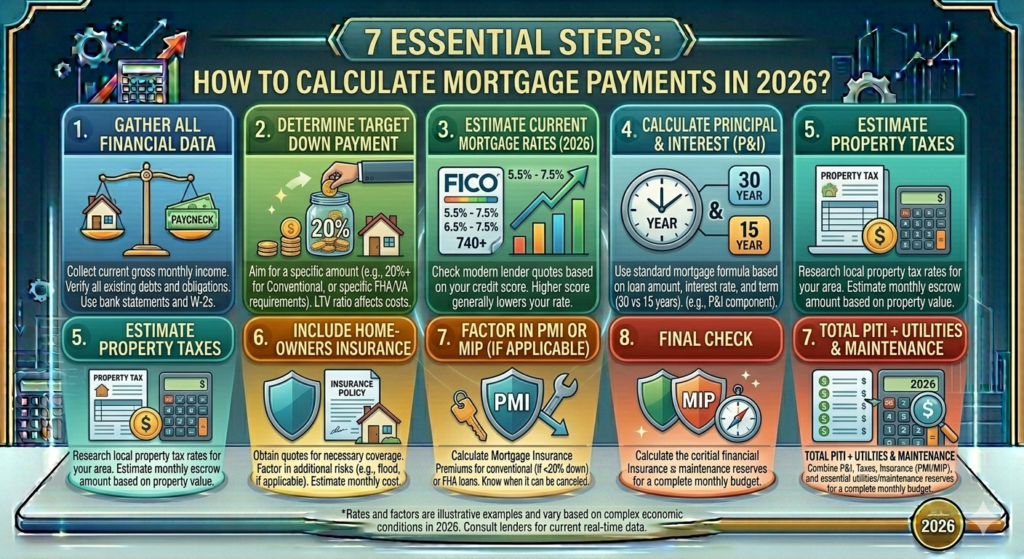
In the world of SEO, we often say “data is the new oil.” In the world of real estate, “cash flow is the new king.” When you type how to calculate mortgage payments into your search bar, you aren’t just looking for a simple math equation; you’re looking for a roadmap to homeownership.
As an SEO expert who tracks high-intent search trends, I’ve noticed a shift in 2026. Buyers are no longer relying solely on the “estimated monthly payment” listed on real estate portals. They want to know the “technical SEO” behind their loan—the exact breakdown of principal, interest, taxes, and insurance. With national average rates currently hovering around 6.34% in April 2026, understanding the variables that drive your monthly bill is the ultimate optimization strategy.
1. The Mathematical Algorithm: The Mortgage Formula
To understand how to calculate mortgage payments, we have to start with the foundational “code.” While most people use an online tool, knowing the manual formula allows you to see how each variable impacts your “ranking” (your affordability).
The standard formula for a fixed-rate monthly payment is:
M=P[(1+r)n−1r(1+r)n]
Breaking Down the Variables:
- M: Your total monthly principal and interest payment.
- P: The principal loan amount (the total amount you borrow).
- r: Your monthly interest rate. (Divide your annual rate by 12. For 6.34%, r=0.0634/12).
- n: The total number of payments (for a 30-year loan, n=360).
If you use this math to determine how to calculate mortgage payments, you’ll realize that even a 0.25% drop in interest rates can save you thousands over the life of the loan.
2. Factor in the “PITI” Metadata
A common mistake when learning how to calculate mortgage payments is focusing only on the “P” and “I” (Principal and Interest). In reality, your bank will likely collect four items every month, collectively known as PITI.
- Principal: The part of the payment that reduces your loan balance.
- Interest: The fee paid to the lender for borrowing the money.
- Taxes: Property taxes collected by your local government.
- Insurance: Homeowners insurance to protect the asset.
2026 PITI Component Breakdown (Table)
| Component | Average Percentage/Cost | Frequency |
|---|---|---|
| Principal & Interest | Based on 6.34% Rate | Monthly |
| Property Taxes | 0.3% – 1.9% of value | Monthly (Escrow) |
| Home Insurance | $100 – $300 | Monthly (Escrow) |
| Private Mortgage Insurance (PMI) | 0.5% – 1.0% (if <20% down) | Monthly |
Export to Sheets
3. The 2026 Property Tax Update
When you research how to calculate mortgage payments, you must account for your “location data.” In 2026, property tax rates vary significantly across the US. If you are buying in New Jersey, you might pay an effective rate of 1.88%, while a buyer in Alabama might only pay 0.37%.
For a $400,000 home, that is the difference between $626/month and $123/month in taxes alone. This is why “local SEO” matters in real estate; your zip code determines a massive chunk of your monthly payment.
4. Understanding Private Mortgage Insurance (PMI)
If you are putting down less than 20%, you need to know how to calculate mortgage payments with PMI included. In 2026, average PMI rates range from 0.5% to 1% of the total loan amount annually.
SEO Pro Tip: Think of PMI as a “penalty” for a weak backlink profile (your down payment). Once you reach 20% equity in your home, you can usually request to have this fee removed, instantly “optimizing” your monthly cash flow.
5. The Role of Interest Rate Volatility
As of April 18, 2026, the mortgage market is experiencing a “7 out of 10” on the variability index. This means that two different lenders might offer you two different rates for the exact same house.
If you want to know how to calculate mortgage payments accurately, you must get a Loan Estimate from at least three lenders. A rate of 6.2% vs. 6.5% might not seem like much, but on a $350,000 loan, that’s roughly $68 per month—or over $24,000 over the life of a 30-year mortgage.
6. Amortization: The “Long-Tail” of Debt
Amortization is the process of paying off your debt over time. In the early years of your loan, the majority of your payment goes toward interest. As your “Domain Authority” (equity) grows, more of your payment is applied to the principal.
If you are looking at how to calculate mortgage payments for a 15-year loan vs. a 30-year loan, the 15-year option will have a much higher monthly payment but will save you hundreds of thousands in interest.
15-Year vs. 30-Year Comparison (Table)
Based on a $300,000 loan at 2026 average rates
| Term | Interest Rate | Monthly P&I | Total Interest Paid |
|---|---|---|---|
| 30-Year Fixed | 6.34% | $1,865 | $371,320 |
| 15-Year Fixed | 5.72% | $2,488 | $147,840 |
Export to Sheets
7. Using Escrow to Automate Your Budget
Most modern lenders require an “escrow account.” This is essentially a savings account managed by the bank to pay your taxes and insurance. When you ask how to calculate mortgage payments, remember that the bank will divide your annual tax and insurance bills by 12 and add that amount to your principal and interest.
In 2026, many homeowners are seeing “escrow shortages” due to rising insurance premiums. It is wise to add a 5% buffer to your calculation to account for these annual price hikes.
8. The Impact of Credit Scores on Your Math
In SEO, a higher Domain Authority (DA) leads to better rankings. In mortgages, a higher credit score leads to lower interest rates.
If you want to see how to calculate mortgage payments for a “prime” borrower vs. a “subprime” borrower, look at the spread. A borrower with a 760 score might get 6.34%, while a 640 score might be quoted 7.15%. On a $400,000 home, that’s a monthly difference of $212.
9. Down Payment Strategies for 2026
Your down payment is the “anchor text” of your loan. The more you put down, the less you borrow, and the lower your monthly bill.
- 3.5% Down (FHA): Accessible, but requires lifelong MIP (Mortgage Insurance Premium).
- 10% Down: Reduces your monthly payment significantly and shortens the time you’ll pay PMI.
- 20% Down: The ultimate “optimization” that removes PMI and gives you the best rates.
When you sit down to learn how to calculate mortgage payments, run the numbers for multiple down payment scenarios to see where your “sweet spot” lies.
10. The Difference Between Interest Rate and APR
When a lender shows you a rate, they often show two numbers: the Interest Rate and the APR. If you want to know how to calculate mortgage payments like a pro, focus on the APR. The APR includes the interest rate plus the fees and points charged by the lender. It represents the “true cost” of the loan.
11. How to Manually Calculate a Monthly Payment (Step-by-Step)
If you have a calculator and want to know how to calculate mortgage payments without a web tool, follow these steps:
- Determine your Principal (P): Purchase Price – Down Payment.
- Determine your Monthly Interest (r): Annual Rate / 12.
- Determine Number of Payments (n): Years * 12.
- Solve the Formula: Plug P,r, and n into the equation from Section 1.
- Add Escrow: Add (Annual Taxes / 12) + (Annual Insurance / 12).
12. Why “Points” Change the Calculation
In 2026, many buyers are “buying down the rate” using discount points. One point typically costs 1% of the loan amount and lowers your interest rate by about 0.25%.
If you are struggling with how to calculate mortgage payments that fit your budget, paying points upfront can be a great way to lower your monthly overhead, provided you plan to stay in the home for more than five years.
Frequently Asked Questions (FAQs)
What is the average mortgage payment in 2026?
As of April 2026, the national average for a new 30-year fixed mortgage on a $400,000 home (with 10% down) is approximately $2,850 per month, including taxes and insurance.
How to calculate mortgage payments if property taxes increase?
If your property taxes increase, your lender will perform an “escrow analysis.” They will divide the new annual tax amount by 12 and increase your monthly payment accordingly.
Does my monthly payment include utilities?
No. When you learn how to calculate mortgage payments, remember that the PITI only covers the house and the loan. You must still budget separately for electricity, water, gas, and internet.
Can I calculate my payment if I have an Adjustable Rate Mortgage (ARM)?
For the initial period (e.g., the first 5 years of a 5/1 ARM), you calculate it just like a fixed-rate loan. However, you must be prepared for the payment to “reset” based on market indexes after that period ends.
Why is my first mortgage payment higher than expected?
Sometimes the first payment includes “prepaid interest” or a larger initial escrow deposit to ensure the bank has enough funds to pay your first tax bill.
How do I calculate the “Break-Even” for paying points?
Divide the cost of the points by the monthly savings they provide. For example, if points cost $3,000 and save you $50/month, your break-even point is 60 months (5 years).
Conclusion
Mastering how to calculate mortgage payments is the most important financial “audit” you will ever perform. In the complex 2026 housing market, you cannot afford to guess. By understanding the PITI components, tracking current 6.34% interest rates, and factoring in your local property taxes, you can build a budget that is both realistic and resilient.
Just like a well-optimized website, a well-planned mortgage requires attention to detail. Don’t just settle for the first number a calculator gives you. Experiment with different down payments, compare APRs, and always account for the hidden costs of homeownership.
Now that you know how to calculate mortgage payments, you are ready to stop searching and start buying. Use this data to negotiate with lenders, talk to your real estate agent, and secure a home that fits your financial “algorithm” for years to come.
Disclaimer: This guide provides estimates based on April 2026 market conditions. For exact figures, please consult with a licensed mortgage professional.