
When you’re competing for a home in Richmond, Chesterfield, Fredericksburg, or Virginia Beach, the clock is always ticking. A slow mortgage approval doesn’t just cause stress — it can cost you the house entirely. Sellers in competitive Virginia markets routinely favor buyers who arrive with verified pre-approvals, not basic pre-qualification letters.
The good news: the right combination of tools, platforms, and mortgage professionals can compress what traditionally takes 45 days into a matter of days — sometimes hours. Whether you’re buying your first home in Glen Allen, refinancing in Midlothian, or relocating to Williamsburg, the tools below are built to move at your pace.
Each resource here is evaluated on speed, credit impact, accessibility, and real-world usefulness for buyers in Virginia, Florida, Tennessee, and Georgia. No fluff — just what actually works when the clock is ticking.
Disclaimer: Mortgage rates and loan terms vary by borrower profile, lender, and market conditions. All rate examples are illustrative. Fetch My Mortgage operates in Virginia, Florida, Tennessee, and Georgia only.
1. Fetch My Mortgage
Best for: Virginia buyers who want to shop hundreds of lenders simultaneously with zero credit score impact.
Fetch My Mortgage is a Virginia-based multi-lender mortgage platform led by Duane Buziak, Mortgage Maestro NMLS#1110647, that shops hundreds of lenders at once using a soft-pull credit check that never touches your score.

Where This Tool Shines
Most mortgage shoppers face a painful dilemma: apply with multiple lenders to compare rates, but risk damaging their credit score in the process. Fetch My Mortgage eliminates that dilemma entirely. The NoTouch Credit system uses a Vantage Score 4.0 soft pull — meaning you can shop hundreds of lenders simultaneously and your credit score doesn’t move a single point.
This matters most in competitive Virginia markets like Short Pump, Henrico, and the Fredericksburg corridor where speed and rate optimization can make or break a deal. The platform also accepts credit scores down to 500, which opens doors that most retail banks and credit unions close at 640 or higher. If your bank said no, this is where you go next.
Key Features
NoTouch Credit (Vantage Score 4.0): Soft-pull technology means shopping hundreds of lenders produces zero impact on your credit score.
Hundreds of Lenders Simultaneously: Instead of applying one lender at a time, your profile is matched across a broad lender network to surface the most competitive rates available to your specific file.
500 Credit Score Floor: Significantly broader than most retail lender minimums, which typically start at 580 to 620 for FHA and 620 to 640 for conventional.
Cash-Out Refinance to 90% LTV: One of the higher LTV thresholds available in the market for cash-out refinancing, giving homeowners access to more of their equity.
24/7 Platform Access with Fastest Close Times: The platform doesn’t keep business hours, and processing speed is a core operational priority — not a marketing claim.
Best For
First-time buyers in Virginia who need a pre-approval without risking their credit. Buyers turned down by banks or credit unions. Self-employed borrowers with complex income. Veterans and active military in Hampton Roads. Anyone in a competitive market where speed and rate optimization both matter.
Pricing
No upfront fee to shop lenders. Standard lender origination fees apply at closing, consistent with industry norms. The comparison shopping itself costs nothing.
2. Rocket Mortgage
Best for: W-2 borrowers with strong credit who want a fully digital single-lender experience.
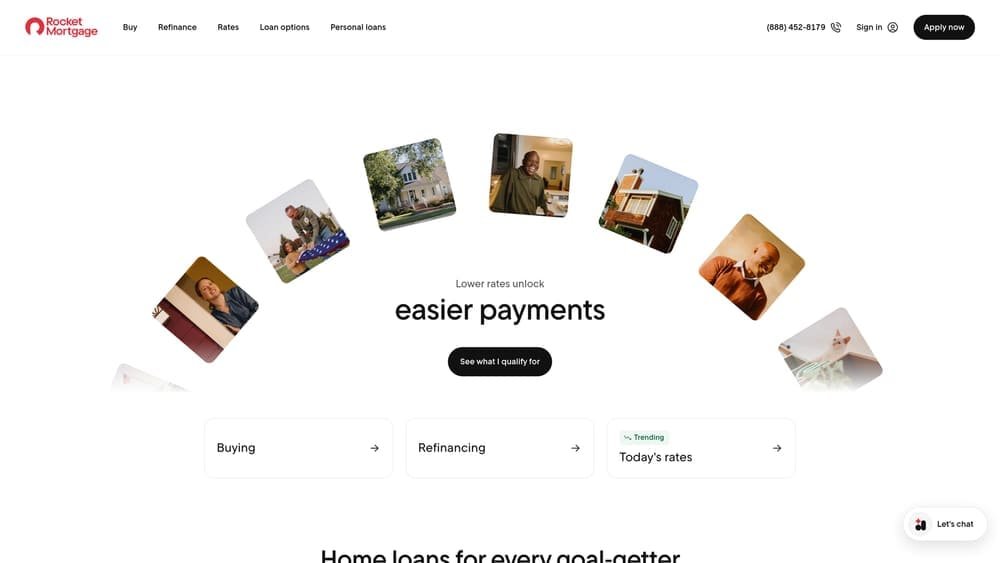
Rocket Mortgage is a national digital mortgage lender offering a streamlined online application with fast automated underwriting for conventional, FHA, and VA loans.
Where This Tool Shines
Rocket Mortgage built its reputation on user experience. The application interface is clean, the conditional approval process is fast for straightforward W-2 files, and the Verified Approval letter carries weight with sellers. For buyers with clean credit and simple income documentation, it delivers on its promise.
The limitation worth understanding: Rocket Mortgage is a single lender. You receive one rate from one source. There is no mechanism to compare that rate against hundreds of competing lenders, and the initial application typically involves a hard credit pull. For buyers who are rate-sensitive or have any credit complexity, that single-lender constraint is a meaningful tradeoff.
Key Features
Fully Digital Application: End-to-end online process from application through approval with minimal paper handling.
Fast Automated Underwriting: Particularly efficient for conventional W-2 borrowers with straightforward files.
Verified Approval Letter: A stronger pre-approval document that can carry more weight in competitive offer situations.
Single Lender: One rate, one set of terms — no cross-lender comparison available within the platform.
Best For
Buyers with strong credit, stable W-2 employment, and straightforward financial profiles who prioritize a polished digital experience over rate comparison breadth.
Pricing
Origination fees vary by loan type and borrower profile. Check current rate disclosures directly at rocketmortgage.com, as fees and rates change with market conditions.
3. AnnualCreditReport.com
Best for: Any buyer who wants to review their full credit file before a lender sees it — at zero cost and zero credit impact.
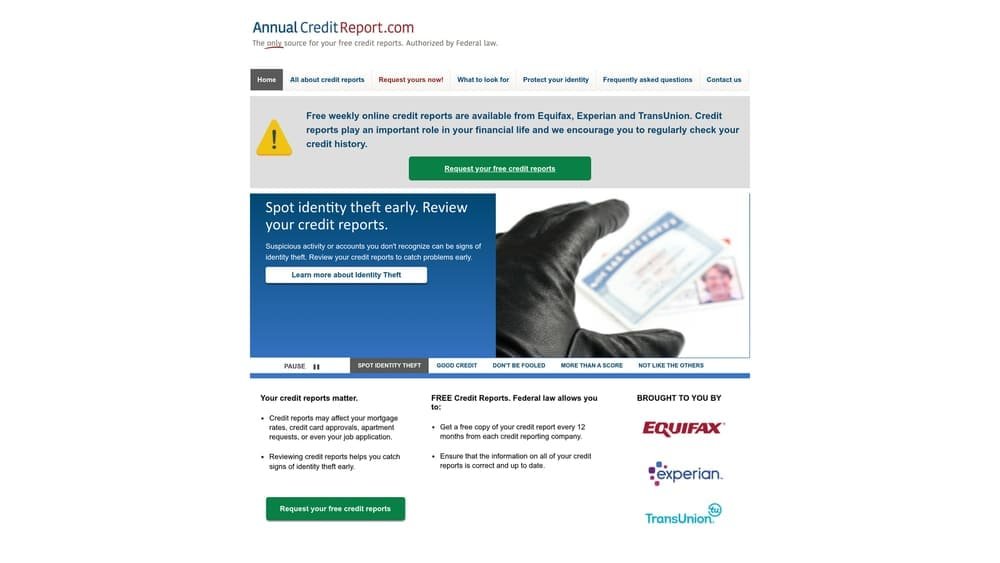
AnnualCreditReport.com is the only federally authorized source for free credit reports from all three major bureaus: Equifax, Experian, and TransUnion.
Where This Tool Shines
Credit errors are more common than most buyers realize. An incorrect late payment, a collection account that was paid but not updated, or a fraudulent account you didn’t open can suppress your score and trigger a lender denial that has nothing to do with your actual financial behavior. Pulling your reports here before you apply gives you the opportunity to dispute errors before they cost you.
This is the starting line for any fast-track mortgage strategy. Knowing what’s in your file — and correcting what’s wrong — is the single most cost-effective thing a buyer can do before engaging a lender. It’s free, it’s federally mandated, and it has zero impact on your credit score.
Key Features
All Three Bureau Reports: Equifax, Experian, and TransUnion reports in one place — because lenders often pull all three.
No Credit Score Impact: This is a soft inquiry. Reviewing your own reports never affects your score.
Federally Mandated Access: No upsell, no subscription required — the free report access is your legal right.
Error Identification: Find and dispute inaccuracies before they appear on a lender’s hard pull.
Best For
Every Virginia homebuyer, without exception. This is step one regardless of your credit situation, income level, or loan type. Run this before you talk to any lender.
Pricing
Free. Mandated by federal law under the Fair Credit Reporting Act.
4. myFICO
Best for: Buyers who want to see the exact mortgage credit scores lenders use — not the consumer-friendly scores that often differ significantly.
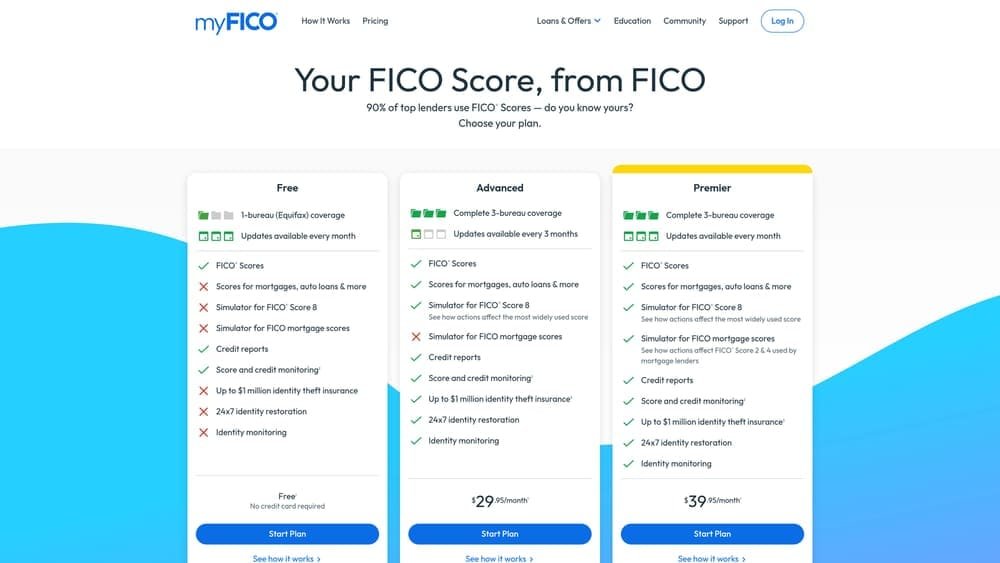
myFICO is the consumer-facing product from FICO that shows FICO Score 2, 4, and 5 — the specific scores mortgage lenders actually pull during underwriting.
Where This Tool Shines
Here’s a detail that surprises many buyers: the credit score your bank app shows you and the score a mortgage lender pulls are often different numbers. Mortgage lenders use FICO Score 2 from Experian, FICO Score 4 from TransUnion, and FICO Score 5 from Equifax — and they typically use the middle score of the three. myFICO is the only consumer platform that shows you these exact scores before a lender pulls them.
The score simulator feature lets you model what would happen to your scores if you paid down a specific card, opened a new account, or let a collection age further. That kind of precision is valuable when you’re 20 points away from a better rate tier or trying to decide whether to wait 60 days before applying.
Key Features
FICO 2, 4, and 5 Scores: The actual mortgage lender scores — not the VantageScore or base FICO 8 that most free tools display.
Score Simulator: Model specific actions and see projected score impact before you make financial moves.
Three-Bureau Monitoring: Tracks changes across all three bureaus with alerts.
Pre-Application Optimization: Helps buyers identify the right moment to trigger a lender hard pull for maximum score advantage.
Best For
Buyers who are close to a score threshold that would unlock a better rate tier, self-employed borrowers managing complex credit profiles, and anyone who has been surprised by lender score discrepancies in the past.
Pricing
Plans start around $29.95 per month. Check current pricing at myfico.com as plan structures are updated periodically.
5. DocuSign
Best for: Buyers and borrowers who need to execute loan disclosures, purchase agreements, and closing documents quickly from any device.
DocuSign is the industry-standard eSignature platform that allows legally binding document execution from any smartphone, tablet, or computer.
Where This Tool Shines
Mortgage timelines have historically been slowed by paper. Overnight mail, in-person signing appointments, and faxed documents add days to a process where days matter. DocuSign removes that friction entirely. From initial disclosures to final closing documents, the entire paper trail can be handled digitally — and the audit trail it generates satisfies lender compliance requirements.
In competitive Virginia markets, the ability to sign and return documents within minutes rather than days is a genuine speed advantage. A buyer who can turn around a signed purchase agreement in 20 minutes while sitting in their car has a material edge over one who needs to schedule an in-person signing appointment.
Key Features
Legally Binding eSignatures: Accepted by virtually all lenders, title companies, and real estate brokerages operating in Virginia.
Mobile-Friendly Execution: Sign from any device, anywhere — no printer, no scanner, no fax machine required.
Eliminates Signing Delays: Removes overnight mail and in-person appointment bottlenecks from the closing timeline.
Compliance Audit Trail: Every signature is timestamped and logged, satisfying lender and regulatory documentation requirements.
Best For
All buyers and borrowers — though it’s especially valuable for those in fast-moving purchase situations where document turnaround speed directly affects outcome. Most lenders provide DocuSign access at no cost to borrowers.
Pricing
Personal plans start at approximately $15 per month. In most mortgage transactions, the lender or title company provides DocuSign access at no direct cost to the borrower.
6. IRS Get Transcript
Best for: Self-employed borrowers, business owners, and anyone whose lender needs tax return verification without the traditional processing delays.
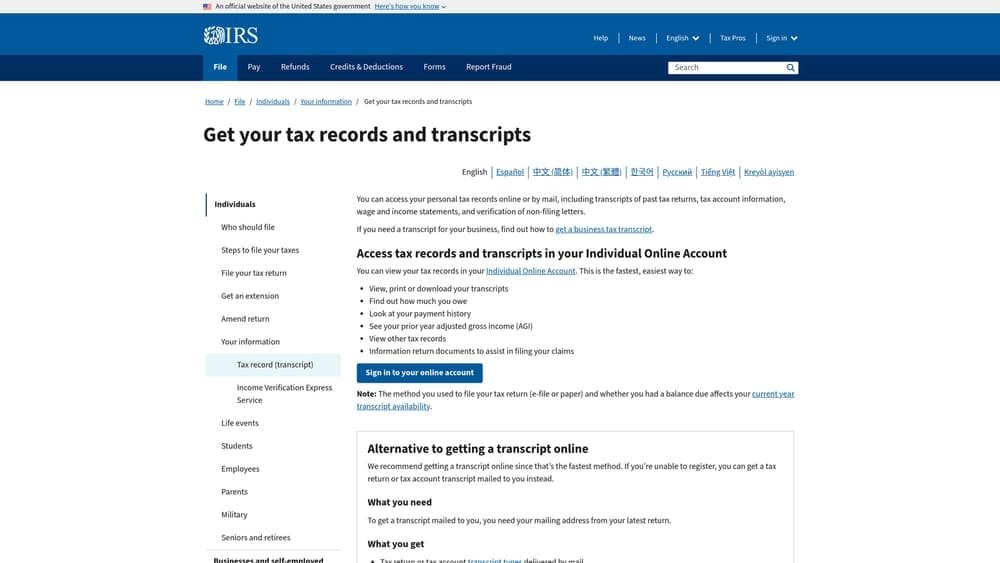
IRS Get Transcript is the official IRS tool for retrieving tax return transcripts online — the same documents lenders request via Form 4506-C during underwriting.
Where This Tool Shines
Here’s a common underwriting bottleneck that catches buyers off guard: lenders are required to verify tax returns directly with the IRS using Form 4506-C. When this process runs through traditional channels, it can add days or weeks to the timeline. IRS Get Transcript lets you retrieve the same documents instantly and provide them directly to your lender, eliminating the wait entirely.
For self-employed buyers in Virginia — a significant population in markets like Charlottesville, Richmond, and the Roanoke and Lynchburg areas — tax return documentation is often the longest pole in the underwriting tent. Arriving at the process with your transcripts already in hand is one of the highest-leverage things a self-employed borrower can do to accelerate approval.
Key Features
Instant Tax Transcript Access: Retrieve IRS transcripts in minutes rather than waiting for lender-initiated 4506-C processing.
Eliminates 4506-C Delays: The traditional IRS verification process through lender channels can take days; direct access removes that bottleneck.
Critical for Self-Employed Borrowers: W-2 employees benefit too, but this tool is especially impactful for business owners and 1099 income earners.
Secure ID.me Verification: Identity verification is required, which protects your tax data while enabling instant access.
Best For
Self-employed borrowers, business owners, contractors, and anyone with complex income documentation who wants to remove a common underwriting delay before it happens.
Pricing
Free. This is an official IRS service with no cost to taxpayers.
7. Plaid
Best for: Buyers whose lenders support digital asset and income verification, replacing manual bank statement uploads with real-time data.
Plaid is a financial data platform that connects directly to bank accounts, allowing lenders to verify assets and income in real time instead of requiring manual statement collection.
Where This Tool Shines
Traditional asset verification involves collecting 60 to 90 days of bank statements, uploading them to a lender portal, and waiting for a processor to manually review each page. Plaid replaces that entire process with a direct, permissioned connection to your bank account that delivers verified data in seconds. For buyers who are time-constrained, this is a meaningful compression of the underwriting timeline.
The practical benefit extends beyond speed. Manual statement uploads often generate follow-up questions from underwriters about large deposits, transfers, or account activity. Real-time data connections provide cleaner, more complete records that tend to generate fewer back-and-forth requests during the review process.
Key Features
Real-Time Bank Account Verification: Connects directly to your financial institution for instant, permissioned data access.
Replaces Manual Statement Collection: Eliminates the 60 to 90 day bank statement upload process that slows traditional underwriting.
Income and Asset Verification: Supports both income verification and asset confirmation in a single connection.
Lender-Integrated: Works within the lender’s platform — borrowers simply authorize the connection when prompted.
Best For
Buyers working with lenders who have integrated Plaid into their underwriting workflow. Particularly valuable for anyone with multiple accounts, variable income, or a need to demonstrate assets quickly in a competitive offer situation.
Pricing
Free to borrowers. Plaid is integrated and paid for by lenders as part of their technology stack.
8. Homebot
Best for: Current homeowners in Virginia who want to track equity, monitor market value, and identify optimal refinance timing without guessing.
Homebot is an automated home equity and market intelligence platform that delivers monthly digests showing your current equity position, estimated home value, and refinance break-even analysis.
Where This Tool Shines
Refinancing at the wrong time is an expensive mistake. Homebot gives homeowners a continuous, data-driven view of their equity position and market value so the decision to refinance is based on math rather than guesswork. The platform tracks appreciation in local Virginia markets and surfaces refinance opportunities when the numbers actually make sense for your specific loan balance and rate.
The break-even calculator is the most practically useful feature. Before you commit to a refinance, understanding how long it takes to recoup closing costs through monthly savings is the critical decision variable. Homebot automates that calculation on a monthly basis so you’re always looking at current numbers, not a one-time estimate that goes stale.
Key Features
Monthly Equity and Market Value Updates: Tracks your home’s estimated value and equity position continuously, not just at point of sale.
Refinance Break-Even Calculator: Automatically computes the break-even timeline so you know whether a refinance pencils out before you apply.
Local Virginia Market Tracking: Monitors appreciation trends in specific Virginia markets, including Richmond, Hampton Roads, and inland counties.
Refinance Window Identification: Flags when market conditions and your loan profile align for a potentially favorable refinance opportunity.
Best For
Virginia homeowners who want a passive, ongoing view of their equity and refinance opportunity — particularly useful in markets like Goochland, Lake Anna, Louisa, and Caroline County where appreciation has been meaningful in recent years.
Pricing
Free for homeowners when provided by a participating lender or real estate agent. Ask your mortgage professional or Realtor whether they have access to provide it.
Illustrative Rate and Payment Reference
When evaluating a refinance or comparing loan offers, understanding the payment impact of different rates on the same loan amount is essential. The table below uses standard 30-year amortization math on a $350,000 loan balance for illustration purposes.
Rate | Loan Amount | Monthly P&I | 30-Year Total Interest
6.00% | $350,000 | $2,098 | $405,280
6.50% | $350,000 | $2,212 | $446,320
7.00% | $350,000 | $2,329 | $488,440
7.50% | $350,000 | $2,447 | $531,000
P&I only. Does not include property taxes, homeowner’s insurance, or HOA fees. Rates are illustrative and subject to change. Actual rate depends on borrower credit profile, loan type, property type, and current market conditions.
Refinance Break-Even: Worked Example
Before committing to a refinance, run the break-even math. Here is a worked example using a $350,000 loan balance:
Current rate: 7.25% | New rate: 6.50%
Current monthly P&I: $350,000 × 0.006816 = $2,385.60
New monthly P&I: $350,000 × 0.006321 = $2,212.35
Monthly savings: $173.25
Estimated closing costs: $5,500
Break-even calculation: $5,500 ÷ $173.25 = 31.7 months (approximately 2 years and 8 months)
Conclusion: If you plan to remain in the home beyond 32 months, this refinance produces a net financial benefit. If you expect to sell or refinance again before that threshold, the closing costs outweigh the savings.
Loan Type Quick Reference
Conventional | Min Credit: 620 | Max LTV: 97% | Best For: Buyers with strong credit and stable W-2 income.
FHA | Min Credit: 500 (10% down) or 580 (3.5% down) | Max LTV: 96.5% | Best For: Buyers with lower credit scores or limited down payment.
VA | Min Credit: No federal minimum (lender overlay typically ~580) | Max LTV: 100% | Best For: Veterans and active-duty military in Hampton Roads, Williamsburg, and across Virginia.
USDA | Min Credit: 640 typical | Max LTV: 100% | Best For: Buyers in rural Virginia counties including Louisa, Caroline, Goochland, and Lake Anna.
Cash-Out Refinance | Min Credit: 500+ | Max LTV: 90% | Best For: Homeowners seeking equity access with a broader lender network.
Frequently Asked Questions
What credit score do I need to get a fast track mortgage approval in Virginia?
It depends on the loan type and lender. FHA loans allow scores as low as 500 with a 10% down payment, and 580 with 3.5% down. Conventional loans typically require 620 or higher. Most retail banks and credit unions set their own overlays, often requiring 640 or above. Fetch My Mortgage accepts credit scores down to 500 and shops across hundreds of lenders to find the best available path for your specific profile.
Does shopping multiple lenders hurt my credit score?
Traditional rate shopping — applying with multiple lenders individually — can generate multiple hard inquiries. However, FICO does provide a rate-shopping window (typically 14 to 45 days depending on the scoring model) during which multiple mortgage inquiries count as one. The cleaner solution is using a platform like Fetch My Mortgage, which uses a Vantage Score 4.0 soft pull to shop hundreds of lenders simultaneously with zero impact on your credit score.
What is NoTouch Credit and how does it work?
NoTouch Credit is Fetch My Mortgage’s soft-pull credit technology. Instead of triggering a hard inquiry that appears on your credit report and can temporarily lower your score, the system uses a Vantage Score 4.0 soft pull. Your credit profile is evaluated and matched against hundreds of lenders without any impact to your score. You only authorize a hard pull when you’ve selected a lender and are ready to proceed with a formal application.
Can I get approved for a mortgage after being turned down by my bank?
Yes — frequently. Banks and credit unions decline mortgage applications for a range of reasons that don’t necessarily reflect your overall borrower quality: credit scores below their internal minimums (often 640 to 680), self-employment income documentation, recent job changes, debt-to-income ratio, or property type. A multi-lender platform with a 500 credit score floor and access to both conventional and non-QM products can often identify a path forward that a single-institution lender cannot. Fetch My Mortgage specifically focuses on converting bank and credit union turndowns.
How fast can I close on a home in Virginia?
Close timelines vary based on loan type, property, and file complexity. Conventional loans with clean documentation can close in as few as 14 to 21 days with the right lender and complete documentation. FHA and VA loans may take slightly longer depending on appraisal scheduling. The fastest close times come from combining a responsive lender network with complete borrower documentation from day one. Having your tax transcripts, bank statements, pay stubs, and identification ready before you apply removes the most common delays.
What documents do I need to speed up mortgage approval?
The core documentation package includes: two years of W-2s or tax returns (1099s for self-employed), 30 days of recent pay stubs, 60 days of bank statements for all accounts, a valid government-issued ID, and Social Security number. Self-employed borrowers should also have business tax returns and a profit and loss statement. Having your IRS tax transcripts pulled in advance via IRS Get Transcript removes one of the most common underwriting delays.
What is the difference between pre-qualification and pre-approval?
Pre-qualification is an informal estimate based on self-reported information — no credit pull, no document verification. It signals general eligibility but carries limited weight with sellers. Pre-approval involves a credit pull, income verification, and asset review. It produces a conditional commitment from a lender and is the document sellers and their agents actually respect in a competitive offer situation. In Virginia’s active purchase markets, arriving with a verified pre-approval is a meaningful competitive advantage.
Which Tool Is Right for Your Situation
The right combination of tools depends on where you are in the process and what’s standing between you and approval. Here’s a direct breakdown by buyer profile.
First-time buyer: Start with AnnualCreditReport.com to review your full credit file, then run a NoTouch soft-pull pre-approval through Fetch My Mortgage to see what hundreds of lenders will offer without touching your score.
Bank or credit union turndown: Go directly to Fetch My Mortgage. The 500 credit score floor and access to a broad lender network — including non-QM options — is specifically designed to find paths that single-institution lenders cannot.
Self-employed borrower: Combine IRS Get Transcript (to have your tax documentation ready before the lender asks), Plaid (for real-time bank account verification), and Fetch My Mortgage for lender comparison across hundreds of sources simultaneously.
Speed-critical purchase in Richmond, Fredericksburg, or Hampton Roads: Fetch My Mortgage’s 24/7 platform with fastest close times, combined with DocuSign for immediate document execution, gives you the tightest possible timeline from application to clear-to-close.
Refinance evaluation: Start with Homebot to understand your current equity position and run the break-even math. Then use Fetch My Mortgage to compare cash-out refinance rates across hundreds of lenders — including the 90% LTV option that most single lenders don’t offer.
The single highest-leverage move any Virginia buyer can make is running a soft-pull pre-approval through a platform that shops hundreds of lenders simultaneously — without touching your credit score. That’s the fast track. Everything else on this list supports and accelerates that core process.