
If your credit score isn’t where you’d like it to be, getting approved for a mortgage in Virginia, Florida, Tennessee, or Georgia can feel like an uphill battle. The reality is that most borrowers who get turned down by a bank or credit union aren’t out of options — they’re simply working with the wrong tools. Lenders and programs exist specifically for borrowers with credit scores as low as 500, and knowing which ones to use can be the difference between a denial letter and a closing date.
This guide covers the most effective tools, platforms, and loan programs available to homebuyers working to secure mortgage approval with bad credit. Each entry is evaluated on credit flexibility, transparency, accessibility, and real-world utility. You’ll also find a direct comparison table, a breakeven rate analysis, and a structured FAQ to help you ask the right questions before you apply.
1. Fetch My Mortgage
Best for: Borrowers with credit scores as low as 500 who want to compare hundreds of lenders without a credit hit
Fetch My Mortgage is a performance-focused mortgage search platform serving Virginia, Florida, Tennessee, and Georgia, connecting borrowers to hundreds of lenders simultaneously using a NoTouch Credit process that does not trigger a hard inquiry during initial rate shopping.

Where This Tool Shines
The core advantage here is access. Every other lender on this page is a single-lender retail operation, meaning your application goes through one underwriting system and either fits or doesn’t. Fetch My Mortgage routes your profile to hundreds of lenders at once, which means a borrower with a 520 score gets matched to lenders who actually want that loan rather than being filtered out by a single overlay.
The NoTouch Credit process uses Vantage Score 4.0, a soft pull that allows full rate shopping without damaging your score. For credit-sensitive borrowers, this is not a small detail. It’s the difference between exploring your options freely and watching your score drop every time you inquire.
Key Features
NoTouch Credit (Vantage Score 4.0): Soft-pull credit review during rate shopping — no hard inquiry, no score impact at the initial stage.
Hundreds of Lenders Simultaneously: Your profile is matched across a broad lender network, maximizing approval paths for complex credit files.
Credit Scores Accepted to 500: Minimum score threshold lower than most retail lenders and national platforms.
Cash-Out Refinance to 90% LTV: Unusually high LTV ceiling for cash-out refinances, relevant for homeowners looking to access equity despite credit challenges.
Bank and Credit Union Turndown Conversion: When a borrower is declined elsewhere, the multi-lender model opens hundreds of alternative approval paths to explore.
24/7 Availability and Fastest Close Times: Around-the-clock access with a track record for speed to closing — critical in competitive Virginia markets.
Realtor Referral Network: Active referral relationships across Virginia markets including Richmond, Chesterfield, Midlothian, Henrico, Fredericksburg, and Hampton Roads.
Best For
Borrowers who have been turned down by their bank or credit union. Buyers with scores between 500 and 619 who need lender-matched options rather than a one-size-fits-all application. Anyone who wants to shop rates without taking a credit hit first. Particularly strong for buyers in Virginia markets from Short Pump and Glen Allen to Williamsburg and Virginia Beach.
Pricing
No upfront fee for rate shopping consultation. Lender fees vary by program and loan type and are disclosed per TRID requirements before any commitment is made.
2. FHA Loan Program (via HUD)
Best for: First-time buyers with credit scores between 500 and 619 who need low down payment options
The FHA Loan Program is the Federal Housing Administration’s flagship mortgage product, designed specifically to expand homeownership access for borrowers with limited credit history or lower scores, available through FHA-approved lenders across Virginia, Florida, Tennessee, and Georgia.
Where This Tool Shines
FHA is the most widely available government-backed loan for bad-credit borrowers, and its guidelines are set by HUD directly. Because the government guarantees a portion of the loan, approved lenders take on less risk, which means they can approve profiles that conventional underwriting would reject outright.
Manual underwriting is available for borderline profiles, meaning a human underwriter can consider compensating factors like employment history, savings, and payment history on non-traditional accounts. This matters for borrowers whose credit score doesn’t fully represent their financial picture.
Key Features
500 Minimum Credit Score with 10% Down: HUD’s official published guideline allows a 500 FICO with a 10% down payment. Source: HUD.gov official program guidelines.
580 Minimum Credit Score with 3.5% Down: The more commonly cited threshold, requiring only 3.5% down for borrowers at 580 or above.
Gift Funds Allowed: Down payment can come from family gifts, which expands access for buyers without large savings.
Manual Underwriting Available: Compensating factors can be considered for borrowers who don’t pass automated underwriting systems.
Government-Backed Approval Rates: Lenders are more willing to approve because the federal guarantee reduces their exposure.
Best For
First-time buyers in Virginia cities like Richmond, Chesterfield, Fredericksburg, and Roanoke with scores in the 500–619 range. Also appropriate for repeat buyers who experienced a credit event like a short sale or bankruptcy and are rebuilding.
Pricing
No direct program cost. Lender fees and Mortgage Insurance Premium (MIP) apply — typically 0.55% to 1.05% annually depending on loan term and LTV. An upfront MIP of 1.75% of the loan amount is also required at closing or can be financed into the loan.
3. VA Loan Program (via VA.gov)
Best for: Eligible veterans, active duty service members, and surviving spouses with credit challenges
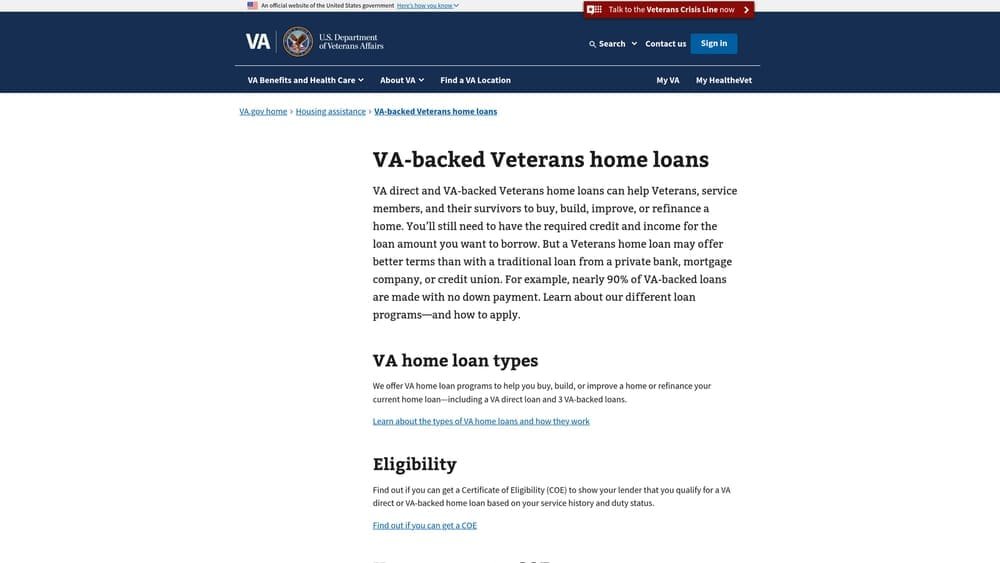
The VA Loan Program is the U.S. Department of Veterans Affairs home loan guaranty program, offering zero-down financing to eligible veterans, active duty service members, and surviving spouses, with no official VA-set minimum credit score.
Where This Tool Shines
The VA loan is the most powerful mortgage product available for eligible borrowers, full stop. No down payment, no PMI, and no VA-set minimum credit score. The VA itself does not require a specific FICO score — individual lenders set their own overlays, often in the 580–620 range, but those overlays are negotiable depending on the lender and the borrower’s full profile.
For veterans in Hampton Roads, Williamsburg, Yorktown, Newport News, and Chesapeake, this program is particularly relevant. The concentration of active military and veteran households in those markets means VA loan expertise is readily available locally.
Key Features
No Official VA Minimum Credit Score: The VA itself sets no floor. Source: VA.gov official loan guaranty program page.
Zero Down Payment: Full purchase price financing available for eligible borrowers.
No Private Mortgage Insurance: Unlike FHA or conventional loans with less than 20% down, VA loans carry no monthly PMI charge.
Competitive Rates for Lower Credit Profiles: Government backing allows lenders to offer favorable rates even for borrowers with credit challenges.
Survivor Spouse Eligibility: Surviving spouses of service members who died in the line of duty may also qualify.
Best For
Veterans and active duty service members in Virginia, Florida, Tennessee, and Georgia with credit scores below 620 who would not qualify for competitive conventional financing. Particularly valuable in military-adjacent Virginia markets.
Pricing
A VA funding fee applies, typically ranging from 1.25% to 3.3% of the loan amount, varying by down payment amount and whether it’s the borrower’s first VA loan use. No monthly PMI. Certain disabled veterans may be exempt from the funding fee — verify eligibility at VA.gov.
4. USDA Rural Development Guaranteed Loan Program
Best for: Buyers in eligible rural and suburban Virginia areas who need zero-down financing with flexible credit
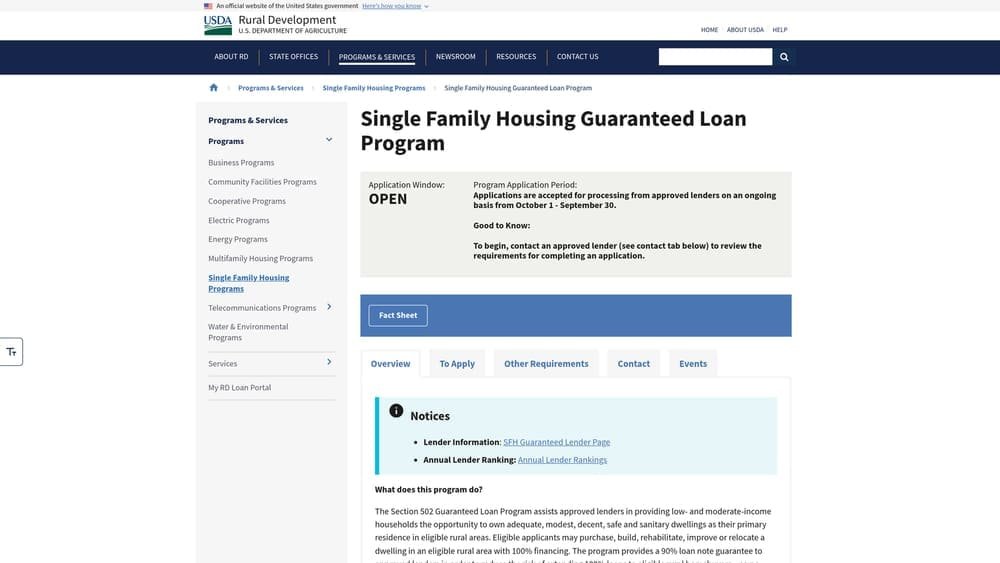
The USDA Rural Development Guaranteed Loan Program is a zero-down mortgage program backed by the U.S. Department of Agriculture for eligible rural and suburban properties, particularly relevant for Virginia buyers in areas like Lake Anna, Goochland, Louisa, Caroline County, Ashland, and parts of Spotsylvania.
Where This Tool Shines
USDA loans are frequently overlooked by borrowers who assume “rural” means remote farmland. In Virginia, many suburban communities within commuting distance of Richmond and Fredericksburg qualify for USDA eligibility. If you’re looking at homes in Goochland, Louisa, or Caroline County, this program may be the most affordable path to ownership available.
USDA guidelines suggest 640 or above for automated underwriting, but manual underwriting is available for lower scores when compensating factors are present. Source: USDA Rural Development official guidelines. A strong employment history, low debt-to-income ratio, or significant reserves can support a manual underwriting approval below that threshold.
Key Features
Zero Down Payment: Full financing available for eligible properties and borrowers.
Manual Underwriting for Lower Scores: Compensating factors can support approval for borrowers below the 640 automated threshold.
Property and Income Eligibility Requirements: Both the property location and the borrower’s household income must meet USDA criteria. Check eligibility at the USDA website.
Lower Annual Fee Than FHA MIP: The 0.35% annual guarantee fee is lower than FHA’s MIP in most scenarios, reducing long-term carrying costs.
Covers Key Virginia Rural Markets: Lake Anna, Goochland, Louisa, Caroline County, Ashland, Hanover, and parts of Spotsylvania and Stafford may qualify.
Best For
Buyers targeting rural or suburban Virginia properties outside major urban cores, with credit scores in the 580–640 range, who want to minimize upfront costs and monthly insurance expenses.
Pricing
1% upfront guarantee fee (can be financed into the loan); 0.35% annual fee. Both are lower than FHA MIP in most scenarios, making USDA one of the most cost-efficient zero-down options available.
5. AnnualCreditReport.com
Best for: Any borrower preparing for a mortgage application who needs to review and clean up their credit before a lender sees it
AnnualCreditReport.com is the only federally authorized source for free credit reports from all three major bureaus — Equifax, Experian, and TransUnion — and is the essential first step for any borrower preparing for a mortgage application.
Where This Tool Shines
Before any lender looks at your credit, you should. Credit reports frequently contain errors — outdated collections, accounts that don’t belong to you, balances that haven’t been updated after payoff. Each of these can be dragging your score down unnecessarily. Disputing and correcting errors before you apply can meaningfully improve your score without changing anything about your actual financial situation.
Weekly free reports are currently available under extended federal authorization, meaning you can monitor your file continuously as you work through disputes and credit improvement steps.
Key Features
Free Access to All Three Bureau Reports: Equifax, Experian, and TransUnion reports are all available at no cost.
Federally Authorized: No upsells, no credit monitoring subscriptions, no hidden fees.
Error Identification: Spot inaccuracies that can be disputed to improve scores before application.
Collections and Judgment Visibility: See exactly what a lender will see before they see it.
Weekly Access Currently Available: Under extended federal authorization, you can pull reports weekly rather than annually.
Best For
Every borrower, regardless of credit score. This is a non-negotiable first step before approaching any lender, including Fetch My Mortgage. Knowing what’s on your report allows you to dispute errors, address collections strategically, and understand exactly where your score stands across all three bureaus.
Pricing
Free. No cost for official reports through this platform. Any site charging for these reports is not the federally authorized source.
6. myFICO
Best for: Borrowers who want to see the exact FICO scores mortgage lenders actually pull — not the estimates shown by free apps
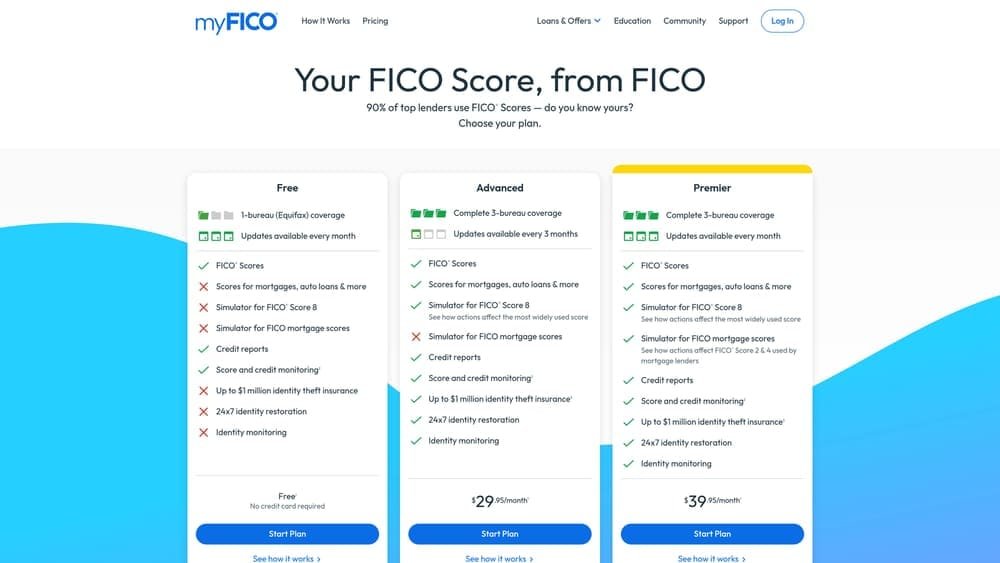
myFICO is the consumer-facing portal from Fair Isaac Corporation that provides access to the specific FICO score versions mortgage lenders actually use: FICO Score 2 from Experian, FICO Score 4 from TransUnion, and FICO Score 5 from Equifax.
Where This Tool Shines
Here’s a frustrating reality many borrowers discover at the worst possible time: the score shown by Credit Karma, your bank app, or most free credit monitoring services is not the score your mortgage lender will pull. Mortgage lenders use specific FICO versions that can differ significantly from the VantageScore models used by consumer apps. A borrower might see a 620 on their banking app and discover their mortgage FICO is 581.
myFICO closes that gap. It shows you the actual scores lenders use, identifies which bureau score is your weakest, and includes simulator tools that model how specific actions — paying down a card, disputing an error, adding a tradeline — would affect your score.
Key Features
FICO Score 2, 4, and 5 Access: The actual mortgage-specific scores used by lenders during underwriting.
Three-Bureau Score Comparison: Identifies which bureau is your weakest link — lenders typically use the middle score of all three.
Score Simulator: Models the impact of specific financial actions on your mortgage FICO scores.
Educational Resources: Explains which score factors matter most for mortgage qualification.
Dispute Guidance: Helps you understand which negative items are most impactful to address first.
Best For
Borrowers who are 3 to 12 months from applying and want to optimize their credit profile strategically. Also valuable for anyone who has been told their score is “borderline” — knowing exactly where you stand on all three mortgage-specific scores helps you target the right improvements.
Pricing
Plans start at approximately $29.95 per month; one-time report options are also available. Verify current pricing at myfico.com before purchasing.
7. HUD-Approved Housing Counseling
Best for: Borrowers who need a structured, unbiased credit improvement plan and mortgage readiness assessment before applying
HUD-Approved Housing Counseling provides free or low-cost pre-purchase counseling through HUD-certified nonprofit agencies, offering unbiased credit improvement plans, budget analysis, and mortgage readiness guidance with no financial incentive to steer borrowers toward any lender.
Where This Tool Shines
The key word here is unbiased. A HUD-certified counselor works for you, not for a lender. They have no commission, no loan to close, and no product to sell. What they provide is a structured assessment of your credit file, your debt-to-income ratio, your budget, and a realistic timeline for mortgage readiness — along with a written action plan.
For borrowers in Virginia cities like Roanoke, Lynchburg, Charlottesville, Albemarle, and Richmond, local HUD-certified agencies are available and can be located through the HUD counselor search tool on their website. This service is particularly valuable for borrowers who are 6 to 18 months away from being ready to apply and want a clear roadmap rather than trial and error.
Key Features
No Sales Incentive: Counselors are nonprofit employees with no financial stake in which lender you choose.
Structured Credit Improvement Plan: Written roadmap identifying specific items to address and in what order.
Budget and DTI Analysis: Evaluates whether your income and debt levels support the mortgage amount you’re targeting.
Mortgage Readiness Assessment: Honest evaluation of how close you are to qualifying and what’s standing in the way.
Virginia Market Availability: Agencies available in Roanoke, Lynchburg, Charlottesville, Albemarle, Richmond, and other Virginia markets through the HUD locator tool.
Best For
Borrowers with significant credit challenges who need a structured plan before approaching any lender. Also required for certain loan programs and down payment assistance options. Ideal for anyone who has been turned down and wants to understand exactly why and how to fix it.
Pricing
Free to low cost — typically $0 to $50 per session depending on the agency. Some agencies offer full counseling at no charge. Verify with the specific agency through the HUD locator tool.
Loan Program Comparison Table
Use this table to quickly compare the key parameters of each loan program covered above.
Program | Min. Credit Score | Down Payment | PMI/MIP | Zero Down Available
FHA (HUD): 500 with 10% down; 580 with 3.5% down | 3.5%–10% | MIP required (0.55%–1.05% annual) | No
VA Loan: No VA minimum (lender overlays typically 580–620) | 0% | No PMI | Yes
USDA Guaranteed: 640 automated; lower with manual underwriting | 0% | 0.35% annual guarantee fee | Yes
Conventional (Fannie/Freddie): 620 minimum | 3%–20% | Required below 20% down | No
FHA via Fetch My Mortgage (multi-lender): 500 minimum | 3.5%–10% | Varies by lender match | No
Note: All program guidelines are subject to change. Lender overlays may apply. Verify current requirements with your loan officer. This table is educational, not a rate quote or commitment to lend.
Breakeven Rate Analysis: Why Your Credit Score Affects More Than Approval
Getting approved is the first goal. But the rate you’re approved at determines your total cost of homeownership over the life of the loan. Here’s a concrete illustration of how a credit score improvement translates to real dollars.
Scenario: $280,000 home purchase, FHA loan, 3.5% down payment.
Down payment: $9,800 | Loan amount: $270,200
At 7.25% rate: Monthly principal and interest = approximately $1,843
At 7.75% rate: Monthly principal and interest = approximately $1,933
Monthly difference: $90
Breakeven analysis: If a borrower spends 3 months improving their credit score to qualify for the lower rate, the savings begin immediately at month one of the loan. Over 30 years, the difference is $90 × 360 months = $32,400 in total interest savings.
Breakeven point on credit improvement effort: Month 1 of the loan — the lower rate saves money from the first payment forward.
Important disclosure: These figures are illustrative calculations only. Actual rates vary by lender, credit profile, loan program, and market conditions at the time of application. This is not a rate quote. All rate disclosures are governed by TRID requirements and will be provided in a Loan Estimate. Rates used here are for mathematical illustration purposes only.
Head-to-Head: Fetch My Mortgage vs. Single-Lender Competitors
Most borrowers searching for mortgage approval with bad credit will encounter several well-known names. Here’s an honest comparison of how the multi-lender model differs from single-lender retail operations.
Fetch My Mortgage vs. Rocket Mortgage: Rocket Mortgage offers a strong digital experience and is well-suited for borrowers with 620+ scores who prefer self-service. It is a single-lender model with a hard credit pull on application. Fetch My Mortgage uses a NoTouch soft pull and accesses hundreds of lenders — a meaningful difference for borrowers with scores below 620 or complex credit files.
Fetch My Mortgage vs. Veterans United: Veterans United specializes exclusively in VA loans and is excellent for veterans with 620+ scores. For sub-580 VA borrowers, the single-lender model limits options. Fetch My Mortgage can match VA-eligible borrowers to multiple VA lenders simultaneously, including those with more flexible overlays.
Fetch My Mortgage vs. C&F Mortgage Corporation: C&F is a respected Virginia-based community lender with a strong local reputation. As a single lender, however, a borrower who doesn’t fit their underwriting profile has nowhere to go within that relationship. Fetch My Mortgage’s multi-lender access means that same borrower has hundreds of alternative paths.
Fetch My Mortgage vs. CapCenter: CapCenter is known in Virginia for low fees and is strong for conventional borrowers. For bad-credit borrowers, their model is less flexible. Fetch My Mortgage’s access to lenders who specifically seek out FHA, VA, and non-QM borrowers with lower scores fills a gap CapCenter doesn’t address.
Fetch My Mortgage vs. Alcova Mortgage: Alcova is a well-regarded Virginia-based lender with solid community roots. Like all single-lender models, approval depends on one underwriting system. Fetch My Mortgage provides access to lenders specifically seeking borrowers with credit profiles that don’t fit standard overlays.
Note: This comparison is educational. All named lenders are legitimate operations with strong track records. The distinction being made is structural — single-lender vs. multi-lender access — not a quality judgment.
Frequently Asked Questions
What is the minimum credit score to get a mortgage in Virginia?
It depends on the loan program. FHA loans allow a minimum of 500 with a 10% down payment, or 580 with 3.5% down, per HUD’s published guidelines. VA loans have no official minimum set by the VA itself, though lenders typically apply overlays of 580–620. USDA loans suggest 640 for automated underwriting but allow manual underwriting for lower scores. Conventional loans (Fannie Mae and Freddie Mac) generally require a 620 minimum. Through a multi-lender platform like Fetch My Mortgage, borrowers with scores as low as 500 can be matched to lenders willing to work with their specific profile.
Can I get a mortgage with a 500 credit score?
Yes, through FHA-approved lenders who follow HUD’s published guidelines. A 500 credit score qualifies for FHA financing with a 10% down payment. Not all lenders accept applications at 500 — many apply their own overlays requiring 580 or higher. A multi-lender platform that accesses lenders specifically willing to underwrite at 500 is often the most effective path for borrowers in this range.
What is a NoTouch Credit check and does it hurt my score?
A NoTouch Credit check uses Vantage Score 4.0, which is a soft pull credit review. Soft pulls do not appear on your credit report as inquiries and do not affect your credit score. This is different from the hard inquiry a lender performs when you formally apply for a loan. The NoTouch process at Fetch My Mortgage allows borrowers to shop rates and explore lender options without any score impact during the initial consultation phase.
How is Fetch My Mortgage different from Rocket Mortgage for bad credit borrowers?
Rocket Mortgage is a single-lender retail operation. When you apply, your profile goes through one underwriting system. If you don’t fit their credit criteria, the answer is no. Fetch My Mortgage routes your profile to hundreds of lenders simultaneously, matching you to lenders who specifically want your loan type and credit profile. For borrowers with scores below 620, this multi-lender model dramatically expands the pool of potential approvals. Additionally, Fetch My Mortgage uses a soft pull during rate shopping; Rocket Mortgage performs a hard inquiry on application.
How long does it take to improve my credit score enough to qualify?
It varies significantly by what’s dragging the score down. Disputing and correcting errors can show results in 30 to 60 days. Paying down high credit card balances can improve a score within one to two billing cycles. Resolving collections or judgments takes longer and depends on the creditor and dispute outcome. A HUD-certified housing counselor can give you a realistic, individualized timeline based on your specific credit file.
What is the difference between a hard and soft credit inquiry for mortgage shopping?
A soft inquiry — like the Vantage Score 4.0 pull used in Fetch My Mortgage’s NoTouch process — does not affect your credit score and is not visible to other lenders. A hard inquiry occurs when you formally apply for credit and is recorded on your report. Multiple hard inquiries from mortgage lenders within a short window (typically 14 to 45 days depending on the scoring model) are often treated as a single inquiry for scoring purposes, but each application still generates a record. For credit-sensitive borrowers, minimizing hard inquiries during the shopping phase is a meaningful consideration.
Can I get approved after a bank turned me down?
Yes, and this is one of the most common situations Fetch My Mortgage addresses. Banks and credit unions operate under a single set of underwriting criteria. If your profile doesn’t fit, the answer is no — regardless of whether another lender would approve the same file. When a borrower is declined by their bank, the multi-lender model means there are hundreds of alternative approval paths to explore. Lenders specialize in different borrower profiles, and a denial from one institution is not a universal verdict.
What loan programs are available in Virginia for buyers with credit scores below 620?
FHA loans are available statewide through approved lenders, with a minimum of 500 credit score. VA loans are available to eligible veterans and service members with no VA-set minimum score. USDA loans are available in eligible rural and suburban Virginia areas including Lake Anna, Goochland, Louisa, Caroline County, Ashland, Hanover, and parts of Spotsylvania and Stafford. Some non-QM (non-qualified mortgage) products are also available through specialty lenders for borrowers who don’t fit agency guidelines. A multi-lender platform can identify which programs you qualify for across all of these categories simultaneously.
Which Tool Is Right for Your Situation
If your credit score is between 500 and 579, your most direct path to approval runs through FHA with a 10% down payment, or through a multi-lender platform that can match you to lenders willing to underwrite at that score. Start with AnnualCreditReport.com to review your file, then initiate a NoTouch Credit check through Fetch My Mortgage to see which lenders are actually available to you. A HUD-certified counselor can help you build a timeline if you’re not quite ready to apply.
If your score is between 580 and 619, you have more options. FHA with 3.5% down is accessible. VA is available if you’re eligible. USDA may apply depending on property location. At this score range, the rate you receive matters as much as whether you’re approved — the breakeven analysis above shows that a 0.50% rate difference on a $270,200 loan translates to over $32,000 in interest over the life of the loan. Shopping multiple lenders isn’t optional at this score tier; it’s essential.
If your score is 620 or above, conventional financing becomes available alongside FHA and VA. You still benefit from multi-lender comparison, but your approval options are broader and your rate sensitivity is lower.
If you’re a veteran in Hampton Roads, Williamsburg, Yorktown, Newport News, or Chesapeake, the VA loan is your strongest starting point regardless of credit score. No down payment and no PMI create a structural cost advantage that other programs can’t match.
If you’ve been turned down by your bank or credit union, that is not the end of the road. It is the beginning of a different road — one that runs through a multi-lender platform rather than a single underwriting system. Learn more about our services and start with a NoTouch Credit review that won’t affect your score.
This article is educational in nature and does not constitute a commitment to lend or a rate quote. Loan approval is subject to credit qualification, income verification, property appraisal, and lender underwriting requirements. All loan programs referenced are subject to change. FHA, VA, and USDA program guidelines are set by their respective federal agencies and are subject to update. Rate figures used in this article are illustrative only and are not representative of current market rates or a specific borrower’s rate. All rate disclosures are governed by TRID requirements and will be provided in a formal Loan Estimate. Programs available in Virginia, Florida, Tennessee, and Georgia only. Not available in all states. Not a solicitation to lend in any state where prohibited.
Author: Duane Buziak, Mortgage Maestro | NMLS#1110647 | Fetch My Mortgage